
❌

Reading view

There are new articles available, click to refresh the page.

Updated Google privacy policy says your Gmail might be used for advertising

Using Google's products and services has always been fundamentally precarious—doing so gives the world's largest advertising company a lot of juicy personal data. Google has long said it won't use the sensitive data from products like Gmail, Drive, and Photos for ad personalization, but a change to the company's privacy policy appears to dismantle that firewall.

On October 16, Google issued an update to its privacy policy, spotted by Android Authority. The ad personalization section used to include a clear limit on data from certain apps. "We don’t show you personalized ads based on your content from Drive, Gmail, or Photos," the document said. Now, Google has updated it with the following language.
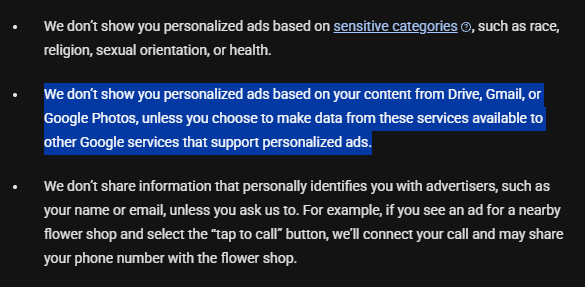
Updated language on when your sensitive data might inform ads. Credit: Google

This equivocation opens the door to using data from apps like Gmail and Photos in ads when it's shared with other Google services, and it just so happens Google has a mechanism for doing that, with Personal Intelligence. The company released Personal Intelligence in early 2026, allowing users to hand data from multiple apps to Google AI products. The idea is that the added context from your existing data will lead to better AI answers, but it's also proving to be a privacy minefield.
Read full article

Comments

© Aurich Lawson

Vance Defends Ramaswamy Ad Featuring Acton’s Mother Despite Backlash

The vice president backed an advertisement featuring Democrat Amy Acton’s mother, who has been estranged from Dr. Acton since her stepfather was charged with child rape.

© Kenny Holston/The New York Times

Vivek Ramaswamy’s campaign for governor of Ohio was engulfed in controversy over an ad featuring the mother of his Democratic opponent.

Meta Earnings Show Increased A.I. Spending, Even as Cash Pressures Grow

The spending has hurt the Silicon Valley giant’s cash flow, which turned negative. Meta said it would issue a new class of stock to help it raise more money.

© Scott Ball for The New York Times

Construction of Meta’s Richland Parish Data Center in Holly Ridge, La.

Attack Ad Featuring Candidate’s Mother Turns Ohio Governor’s Race Even Uglier

A Republican ad features Amy Acton’s estranged mother calling her daughter a liar. The two have not spoken since Dr. Acton’s mother backed her husband after his arrest on rape charges.

© Kenny Holston/The New York Times

Republicans Barely Mention Trump in Political Ads Ahead of the Midterms

Only a small fraction of recent G.O.P. broadcast and streaming ads mention the president, according to a Times analysis of ad data.

© Kenny Holston/The New York Times

President Trump, seen on a partially covered television screen, during a speech earlier this year.

U.S. Political Money Funnels to Indian Bots to Lure Voters

At least three dozen videos of people on the street expressing support for a Democratic candidate appeared millions of times on social media. It was unclear who paid for them.

© Nick Hagen for The New York Times; Nic Antaya for The New York Times

Meta Withdraws $25 Million from Its Midterms Push

The company outlined a $65 million budget last year when it embarked on an effort to elect state politicians friendly to the A.I. industry.

© Gabriela Bhaskar/The New York Times

Meta’s annual conference last month in Menlo Park, Calif. The company received $22 million back from its American Technology Excellence Project and $3 million from a California advocacy group it funded.

An Army of Paid Creators Is Carpeting the Web With Political Content

Unlike celebrity influencers with large followings, these creators produce a blizzard of videos for a fraction of the cost of traditional online campaigns and, in the process, shift public conversation.

© The New York Times

Judge Orders Data Sharing and Other Fixes to Solve Google’s Ad Tech Monopoly

The measures, which fall short of a breakup demanded by the government, effectively ensure that the tech titan’s business will continue largely unscathed.

© Lucas Foglia for The New York Times

Google offices in San Francisco.
❌