❌

Reading view

There are new articles available, click to refresh the page.

Worms mate in man's eyes, get plucked out right before larvae burst out

After two months of discomfort, a man in South Korea went to an eye clinic where doctors pulled 11 living, wriggling worms from his eyes. They apparently made the most of their time on the man's peepers; at the time of extraction, many of the female worms were pregnant. The man narrowly avoided having them spew their loads of living larvae directly into his eyes.

The man in this case was a 71-year-old crop farmer. He told doctors that for the previous two months he had the sensation of having something stuck in both his eyes, which were also red and blurry. When ophthalmologists took a look, they quickly saw the problem: multiple mobile, whitish roundworms. His eyes were not in good shape either, as one might expect. The blood vessels in the membrane over the eye, the conjunctiva, were enlarged, making his eyes look red. And the cells of his corneaβ€”the transparent, dome-shaped outer layer of the eyeβ€”had eroded, potentially after the helminths' hanky-panky.

According to a case report published in the New England Journal of Medicine, the doctors gave the man a topical treatment to numb his eyes and then began plucking out the worms one by one with fine forceps. They collected 11 adult worms, which ranged in size from 11 to 22 mm.


Read full article

Comments

Β© New England Journal of Medicine, 2026

US official: Russia's stalker satellite sure looks like an orbital weapon

Four years ago, a senior official in Russia's foreign ministry painted a bullseye on commercial satellite networks that assist Ukraine in its fight against invading Russian military forces.

On Wednesday, several days after a Russian military spacecraft moved within striking distance of one of those commercial satellites, the same Russian diplomat assured the world there's no reason to worry.

There's a sharp incongruity in those statements from Konstantin Vorontsov, deputy head of Russia's delegation to the United Nations. Vorontsov's comments Wednesday in the UN General Assembly's First Committee came moments after a US official called attention to recent maneuvers by Kosmos 2612, a Russian military craft that approached a US-registered commercial satellite some 340 miles (550 kilometers) above Earth.

Read full article

Comments

Β© UN General Assembly

Russian spacecraft maneuvers in "extreme proximity" to satellite used by Ukraine

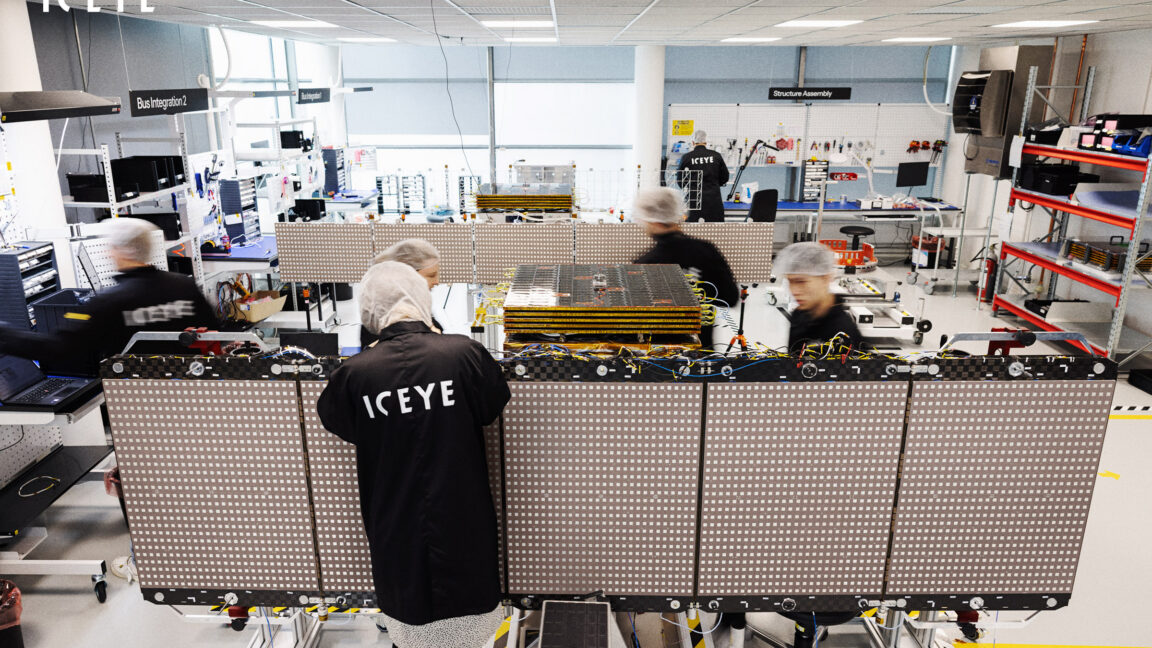
A Russian military satellite maneuvered in "extreme proximity" of a commercial Earth-imaging satellite in recent days in the first known example an unsanctioned rendezvous in low-Earth orbit, according to orbital intelligence company LeoLabs.

The Russian spacecraft, Kosmos 2612, "conducted a deliberate series of maneuvers toward ICEYE-X36, a US-operated commercial imaging satellite," LeoLabs said. "Kosmos 2612 closed from hundreds of kilometers away to extreme proximity to ICEYE-X36. It then maneuvered around ICEYE-X36, remained nearby for an extended period, and then began moving away."

US military officials and independent analysts have tracked Kosmos 2612 since its April launch on a Soyuz rocket from a spaceport in northern Russia. Within weeks, it became apparent that at least four of the six satellites from that launch were stalking ICEYE-X36 after they adjusted orbits to line up with the orbit of the ICEYE spacecraft.

Read full article

Comments

Β© ICEYE

Stratospheric airship flew from US to Japan to test sky cell tower concept

Nearly 100 years after the dirigible Graf Zeppelin made the first nonstop airship journey across the Pacific Ocean, another airship has successfully completed a round-trip flight from New Mexico to Japan and back. But the significance of this modern feat was less about the journey's length and more about its purpose: demonstrating how a lighter-than-air platform can act as a cell phone tower in the sky.

The trans-Pacific flight that took place over a month between August and September 2026 was the most notable milestone yet for Sceye, a US aerospace company based near Albuquerque, New Mexico. Sceye has developed an uncrewed platform filled with helium for buoyancy and equipped with an electric-powered propeller for active propulsion, allowing it to resist most strong winds and keep hovering over the same location for long periods. The platform also uses top-mounted solar panels and onboard batteries to stay powered for stratospheric operations around the clock.

β€œWe can stay over an area of operation, and we do that in the stratosphere right around 60,000 feet, so we're twice as high as air traffic and we're above the jet stream, and yet 30 times closer than low-Earth orbit satellites,” Mikkel Frandsen, founder and CEO of Sceye, told Ars. β€œWe can fly through day and night until the sun comes up the next morning and recharges the batteries, at which point we're still at the same altitude and still over the same area of operation.”

Read full article

Comments

Β© Sceye

❌