
 Login
Login
Scientists solve 1840s space weather mystery
The infamous Carrington Event of 1859 has long been considered the first extreme space weather event, but there have been reports of minor disturbances to telegraph equipment during geomagnetic storms since the late 1840s. In 2013, scholars discovered an anonymous report published in 1871 in Nature describing how a "very intense magnetic disturbance" disrupted rail travel in Exeter on the southern coast of England in October 1841. If accurate, this would be the earliest such account. However, according to a paper published in the journal Space Weather, that 1841 date is most likely a typo, with the real railway disruption occurring several years later.
"Space weather is often discussed as a modern challenge because of our dependence on technologies such as satellites, communications systems and electricity networks," said co-author Jim Wild of Lancaster University. "What this study shows is that society has been experiencing the effects of space weather on technology for almost as long as electrical technologies have existed. The Exeter train delay is a fascinating story because it sits right at the point where emerging technologies first began to encounter the realities of the space environment."
The Carrington Event remains the most powerful geomagnetic storm in the scientific record, with strong auroral displays occurring all over the world, causing sparking and even a few fires in telegraph stations. Some of the auroras were so bright that people reported being able to read the newspaper by their light. The telegraph was a relatively new technology at the time, having first emerged in the 1830s, and the geomagnetically induced current—from a likely coronal mass injection from the Sun—knocked out telegraph systems. Some operators found they were still able to transmit and receive messages even after disconnecting the power supply, relying just on the powerful auroral current.
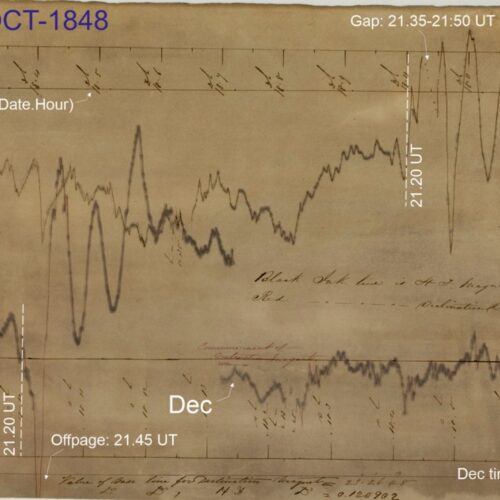
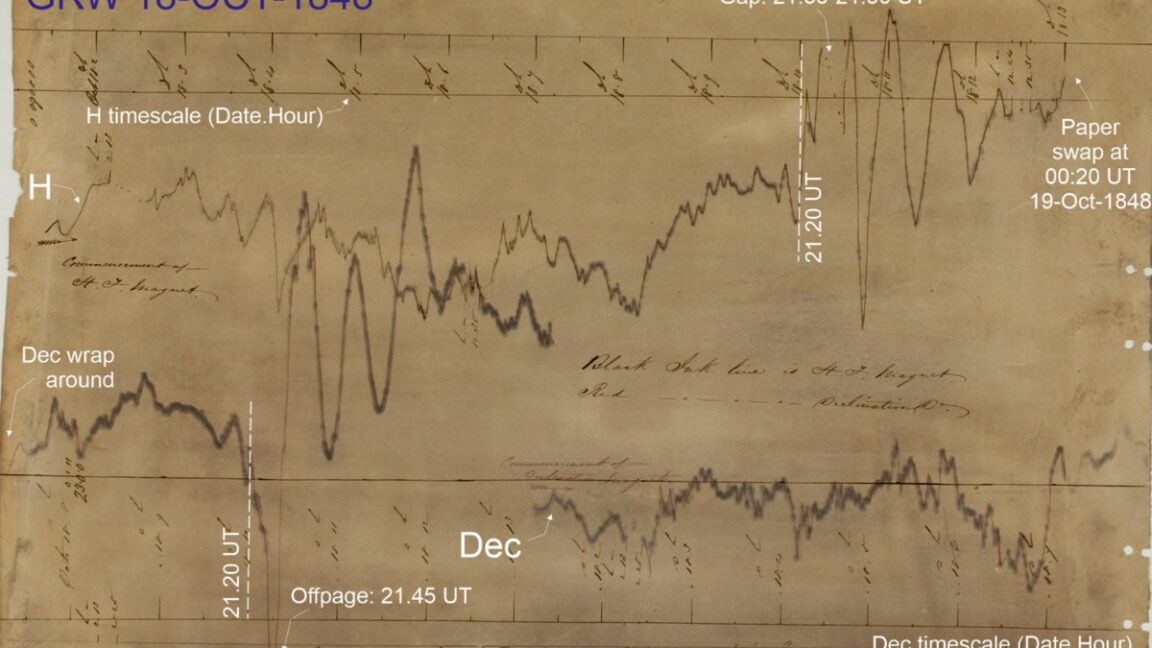
© J.A. Wild et al., 2026
