❌

Normal view

There are new articles available, click to refresh the page.
Today — 7 November 2026Ars Technica

British soldier ignored order to pull his SIM card, then got blackmailed

7 November 2026 at 11:00

An Estonian newspaper recently revealed that a British soldier disobeyed a direct order to remove the SIM card from his cellphone before being deployed to a part of Estonia, approximately 90 miles west of the Russian border.

As a result of his refusal to engage in this element of operational security (opsec), the soldier, Daniel Barton-Kennedy, had his phone hacked, and nude photos of himself were stolen and used as blackmail against him.

Eventually, Barton-Kennedy was court-martialed for disobeying a lawful command, pled guilty, was reduced in rank, and ordered to serve 10 months in detention.

Read full article

Comments

© Mateusz Wlodarczyk/NurPhoto

Yesterday — 6 November 2026Ars Technica

Chainalysis says hackers stole credentials and tokens for all of its customers

6 November 2026 at 20:56

Blockchain analysis firm Chainalysis said that hackers have obtained sensitive personal information—including names, usernames, password hashes, and live tokens—for all of its users following a breach of its network security.

The accomplishment could be a major coup for the attackers. Both Chainalysis and public sources have revealed a long list of high-profile customers, including government agencies such as the FBI, US Immigration and Customs Enforcement agency, and the US Air Force, as well as private companies such as Microsoft, Coinbase, and Barclays. It's unclear if the data theft exposed customers to additional threats.

We regret to inform you...

Last Friday, Chainalysis said it had been the target of a cybersecurity incident in October that was similar to the hacks of other platforms during the same month. The external actor used AI agent-assisted offensive techniques to gain unauthorized access to Chainalysis systems and internal tools. An email the company sent to affected customers said some “non-sensitive customer data, such as user IDs, full names, email addresses, and organization role labels for users provisioned on our platform were accessed.” It's not clear why the company considered such information "non-sensitive."

Read full article

Comments

Meet *sshole, the vulnerability that lets hackers SSH into Linux devices

5 November 2026 at 23:09

Devices running some configurations of Alpine Linux, and possibly other distributions, are affected by a decade-old vulnerability that allows attackers to log into devices with no password.

The vulnerability exists in the interaction between OpenSSH, the code library implementing SSH connections, and musl, a lightweight alternative to the libc library that, unlike most other Linux distributions, is used in Alpine. Further, OpenSSH using musl (pronounced muscle) must not use PAM (pluggable authentication modules), a framework that handles user authentication and account-access checks. Alpine is a lightweight, widely used Linux distribution. Other platforms may be affected if they use the same configurations.

One connection, works every time, needs no retries

There are two other conditions necessary for successful exploitation. First, a system must have at least one user account that’s accessible using a password that is hashed using the SHA256 or SHA512 functions. Second, the target system account must be configured to be passwordless, by way of specifying a "*" in the password field in /etc/shadow, the Linux file where password hashes are stored. Passwordless accounts are commonly used for accounts that use certificate-based authentication. This setting is common for certain types of accounts.

Read full article

Comments

© Getty Images | Sergey Balakhnichev

Before yesterdayArs Technica

Hackers exploited iOS and Android flaws to infect phones

4 November 2026 at 22:26

Hackers possibly linked to the Kremlin exploited previously patched iOS and Android flaws in an attempt to hack visitors of multiple websites, including one celebrating the 250th anniversary of American independence, researchers said Wednesday.

The attackers, which the researchers assessed with “moderate to high confidence” were part of Russia’s Foreign Intelligence Service, targeted other sites, many with links to that country’s ongoing war against Ukraine. The attacks began when iPhone or Android users visited one of potentially hundreds of different sites. JavaScript injected into the traffic then profiled the device. The final payloads, tailored to the type of platform visiting, attempted to steal browser cookies and, in some cases, Wi-Fi passwords and full mobile device data.

Wielding DarkSword

One of the impersonated sites was america250.org, belonging to a non-partisan group of lawmakers, business executives, and at least one former member of the Trump administration. The attackers registered america250[.]holiday and used it as a reverse proxy to america250.org. The imposter website delivered content from the real one but added malicious JavaScript into it.

Read full article

Comments

© Getty Images

Binance says hackers who stole billions in crypto spent months planning heist

4 November 2026 at 16:06

The hackers who stole billions of dollars in cryptocurrency from the Binance exchange spent months working on the theft and used both social engineering and novel malware in the process, the company said Tuesday.

The heist, which both the FBI and the TRM Security firm attributed to North Korean actors, initially targeted $6.34 billion in cryptocurrency from Binance wallets. The exchange has since frozen or intercepted $2.85 billion of that sum. Binance said it has set aside funds required to cover the loss and provided this link to a Proof of Reserves page. The $6.34 billion represents the biggest sum ever targeted in a cryptocurrency theft.

Advanced persistent threat

Binance said the people behind the heist began no later than June and continued until last Thursday, when they successfully compromised an engineer's laptop and withdrew assets from several wallets. Like just about every organization that suffers a public, high-consequence hack, Binance said the threat actor was sophisticated and resourceful.

Read full article

Comments

© Dan Kitwood/Getty

Google dismantles botnet secretly running on 1.3 million Android TV boxes

3 November 2026 at 17:08

Google's Threat Intelligence Group says it has shut down a massive botnet called x.cpe. At its height, x.cpe ran on more than 1.3 million Android TV devices, and unusually, these were Google-certified boxes. Google says its screening process missed the malware due to "obfuscation techniques" employed by Shenzhen-based Videostrong Technology.

In a detailed blog post, the Threat Intelligence Group explains how the x.cpe botnet evolved quickly from a single-stage dropper into a modular three-stage malware platform that sold access to third parties. Manufacturers must have their devices certified if they want access to Google apps and branding, a process that is supposed to catch threats like this. However, Videostrong's compromised boxes, mostly sold under the MECOOL brand, evaded detection by using a backdoor to remotely install the malware after the devices were set up and online.

After devices appeared online, a stub application called x.cpe or com.oemservice would phone home. This package did not have any malicious capabilities of its own, but it had the system-level permissions necessary to install malware modules at the operator's behest. It also disabled Play Protect, which would have otherwise flagged the silently installed packages as malicious.

Read full article

Comments

© Google

UEFI bootkit infected fully patched Windows machines. Is Microsoft to blame?

3 November 2026 at 16:03

In 2023, malware tracked as BlackLotus became the first publicly documented in-the-wild UEFI bootkit capable of bypassing Secure Boot on fully updated Windows 11 systems. With the industry-wide chain-of-trust mechanism subverted, the malware was able to run malicious code before Windows was fully loaded and many security defenses were operational.

Microsoft had already patched the vulnerability that BlackLotus exploited in 2022. In 2023 and 2024, Microsoft issued additional updates. The first added a new certificate that no longer trusted the vulnerable boot managers. The second provided the means to revoke trust in the digital certificate used to sign older vulnerable Windows boot managers. The organizations infected by the new bootkit, which is tracked under the name BlackX, had installed all of these patches. So how did they fall victim?

UEFI bootkit refresher

Before discussing the incident further, a brief review of BlackLotus and UEFI malware is in order. Short for Unified Extensible Firmware Interface, UEFI is firmware that runs immediately after a computer is turned on. One of its main jobs is to load system configuration settings, identify and initialize hardware components, and prepare the computer to start its OS.

Read full article

Comments

© Getty Images

Anthropic VS code extension on Cursor backdoored for nearly 12 hours

30 October 2026 at 21:09

An official extension for Anthropic’s Claude model was backdoored and threatened as many as 5,000 developers' machines, multiple sources reported Friday. Anthropic so far has yet to warn customers of the incident.

The compromised package was a VS Code extension available in the marketplace of Cursor, a maker of AI-assisted developer tools, the company said Friday. The malicious version, 2.1.313, subsequently affected “at most 5,000 users,” presumably when they either downloaded it or their systems automatically fetched and installed it. Anthropic pushed version 2.1.314 several hours after the previous version became available on Cursor, according to independent researcher Kevin Beaumont. Both Beaumont and the CTO and co-founder of security firm Phorion said that version 2.1.313 was distributed through Anthropic’s official account on Cursor. So far, neither Cursor nor Anthropic has explained how the attackers gained control of the account.

In search of cloud credentials

“It was a supply-chain compromise where the attacker gained access to the official distribution channel,” Phorion CTO and co-founder Luke Roberts told Ars. “The malicious version 2.1.313 was posted to the official Anthropic account, effectively superseding 2.1.312. Extensions auto-update in Cursor by default, but users can configure this in settings.” Phorion has more details here.

Read full article

Comments

© Getty Images

Hackers steal $6.3 billion from Binance in record crypto heist

30 October 2026 at 13:46

Binance has suspended all withdrawals after the world’s largest cryptocurrency exchange fell victim to what appears to be the biggest heist in history.

The exchange put the “estimated total impact” of the hack at about $6.3 billion and said around $3 billion of affected assets, mainly stablecoins that act as cash for the crypto market, had been frozen.

But analysts at Elliptic said the attacker had changed about $3.3 billion into digital assets that could not be frozen and was working to cash those out as traditional currency.

Read full article

Comments

© Dan Kitwood/Getty

Massive leak exposes 41,000 DHS workers and undercover ICE agents

29 October 2026 at 12:58

An unprecedented leak of Department of Homeland Security records has exposed details of more than 41,000 employees or contractors who work for the department and its constituent agencies. The records include email addresses, phone numbers, and office addresses, but also references to internal systems and sensitive information on undercover and surveillance programs. In all, the leak provides a map of how DHS is organized and how it operates.

The records, which span DHS itself as well as seven component agencies, including Immigration and Customs Enforcement and US Customs and Border Protection, were last updated on August 19, 2026. The transparency nonprofit Distributed Denial of Secrets and cybersecurity researcher and journalist maia arson crimew previewed the data for WIRED, which they say they obtained from a group calling itself the Department of Peace.

DDoSecrets published the archive, which it calls “Icepick,” on Wednesday. In a press release, DDoSecrets says the data is from DHS's Okta login system. In a note with the files, the hackers wrote, “They have our information, so it’s only fair that we have theirs.”

Read full article

Comments

© Adam Gray/Getty

Code-execution flaw in UEFI firmware affects most servers on planet Earth

27 October 2026 at 20:25

Defenders across the world face the burden of responding to yet another botched code-execution vulnerability, this time in boot-time firmware used by most of the world’s server vendors and data centers.

The vulnerability, with a severity rating of 9.5 out of 10, resides in the TianoCore EDK II, an open source codebase that hardware makers and cloud providers use to create the UEFI firmware that runs during the boot-up sequence. Last year, a representative of the UEFI Forum called EDK2 the "preeminent solution / implementation of the UEFI specifications." Virtually all UEFI suppliers (sometimes still called IBVs or independent BIOS vendors), including AMI, Insyde, and Phoenix, use the reference code extensively. Project Mu, Microsoft's hardened EDK2 fork, used the code containing the vulnerable component as well.

The vulnerability, tracked as CVE-2026-97631, is a memory-corruption flaw in an ICMP component that attackers can exploit to execute malicious code that runs before the operating system and firmware can implement defenses like Secure Boot, which establishes a chain of trust for all code, including the Trusted Platform Module (TPM), loaded during boot. While final payloads delivered by CVE-2026-97631 have no persistence—meaning they run only once—they can give attackers a wide opening to install other payloads that also run each time early in the boot process.

Read full article

Comments

© Getty Images

ICE plan to buy robot dogs spurs protest from hundreds of Boston Dynamics employees

26 October 2026 at 18:50

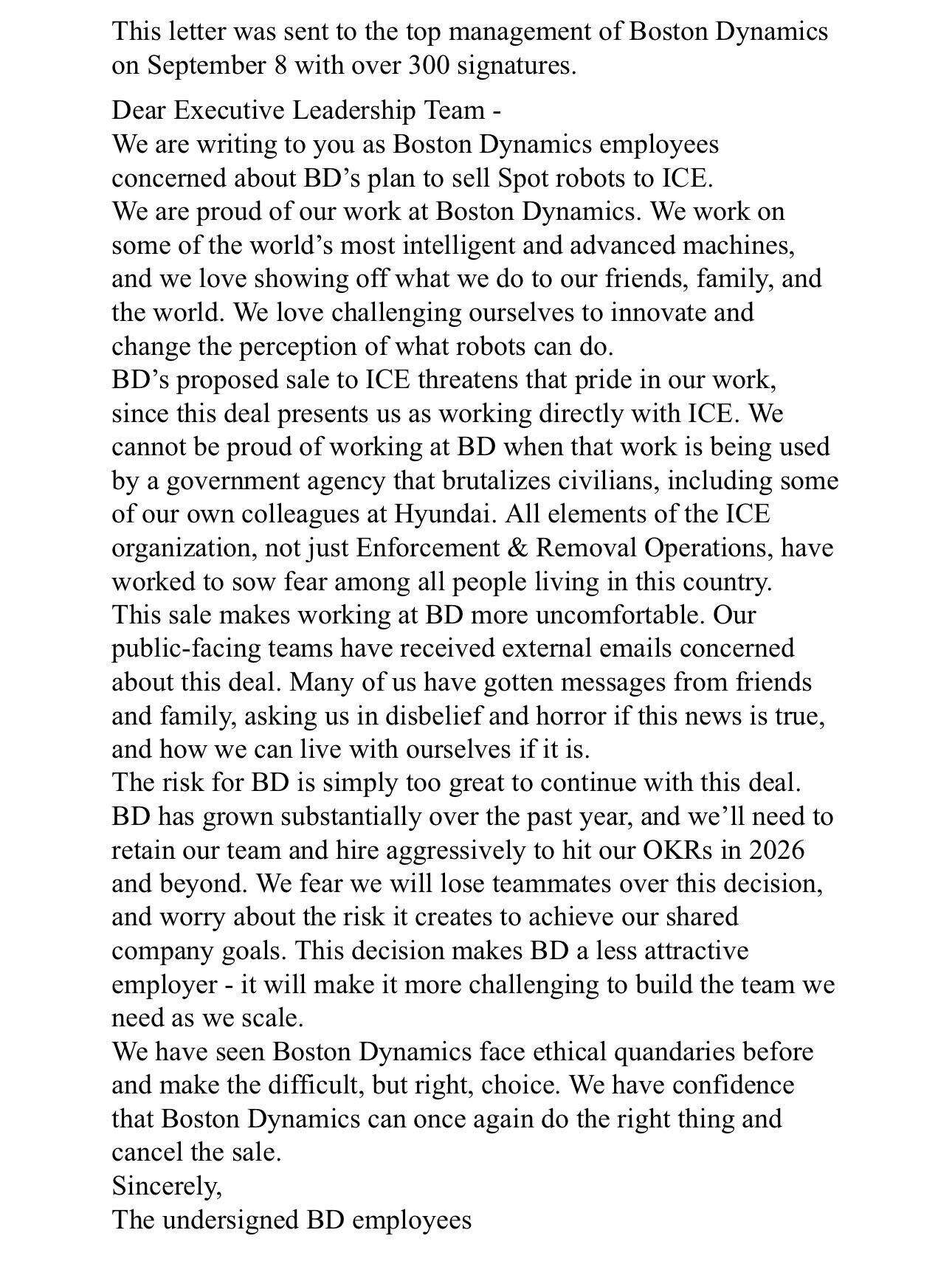
Hundreds of employees at the US robotics firm Boston Dynamics signed a petition calling for executives to halt a sale of the company’s robot dogs to US Immigration and Customs Enforcement—but executives stood by the deal, while saying the robots would not be weaponized.

On September 25, the Department of Homeland Security contract awarded $1.3 million to a Connecticut company called Radeco to provide ICE with modified versions of Boston Dynamics’ quadruped robots. But Boston Dynamics workers sent the petition letter with more than 300 signatures—half of them anonymous—to the company’s executives in early September and shared copies with The Boston Globe and WBUR public radio station.

“Many of us have gotten messages from friends and family, asking us in disbelief and horror if this news is true, and how we can live with ourselves if it is,” according to the petition. “The risk for Boston Dynamics is simply too great to continue with this deal.”

Read full article

Comments

© Radeco

Knicks sent employees fake offer of championship rings in phishing test: Report

23 October 2026 at 16:51

The New York Knicks organization sent employees a phishing email promising free championship rings in a test of its staff's ability to detect scams, The New York Times reported yesterday. “Congratulations, your Employee Championship Ring is here,” the email sent in late September said, instructing employees to click a link to make a selection from two ring designs.

Madison Square Garden employees who clicked that link "were forced to attend a mandatory cybersecurity class to help satisfy some of [owner James] Dolan’s growing cybersecurity concerns," the report said, citing team sources. Dolan is the owner of the Knicks, the New York Rangers, and Madison Square Garden.

It's common for corporations to send phishing emails to find out which employees don't pay attention to clues that an email is a scam. A cybersecurity-test email often appears to be from the company itself but includes telltale signs of phishing. For example, Ars Technica owner Condé Nast sends phishing-test messages from email addresses with a misspelled domain, "condenest.com."

Read full article

Comments

Disgraced eMudhra drops out of TLS business after using cert private key of 4

22 October 2026 at 20:17

eMudhra, the certificate authority that issued eight intermediate TLS credentials so weak that anyone could mint certificates for any website or mail server—one had a private encryption key of just 4—said it’s getting out of the business.

V. Srinivasan, chairman of India-based eMudhra Limited, cited increasing costs and complexities of compliance requirements—paired with the business generating just 1 percent of its revenue. He also said that the emergence of organizations providing TLS certificates free of charge further reduced returns on investment when compared to other products and services the company offers.

Don't let the door hit you on the butt

“However, the level of social media amplification around this incident has brought scrutiny that is out of proportion to SSL/TLS’s place in our business,” the company continued in a Thursday post. “In view of this, after detailed deliberations our board has concluded that withdrawing from global SSL/TLS is the right decision for eMudhra and its shareholders.”

Read full article

Comments

© Getty Images

Hackers got a four-day head start on epic PHP2Shell vulnerability

Amazon has warned that vulnerabilities in a programming language that underpins much of the Internet, discovered using AI tools, are being “broadly exploited” as governments and companies rush to secure their systems.

The world’s largest cloud computing provider on Wednesday said it had identified an attempt by hackers to exploit the bug four days before the weakness was disclosed to the public.

Amazon added the flaws were “now being broadly exploited in the wild.”

Read full article

Comments

© Getty Images

333 Tor exit nodes hijacked to intercept SSH traffic and retrieve plaintext email

22 October 2026 at 11:30

Unknown hackers hijacked more than 300 Tor exit nodes and reconfigured them to favor unencrypted email traffic and redirect SSH connections through servers they controlled, a researcher reported Tuesday.

The hijacking began in late August, when, according to Tor volunteers, the attacker used a valid password that had been reused to gain access to a Tor management server. The attacker then installed Ebury, a backdoor written for Linux that was discovered 12 years ago.

Mysteries remain

Then the attacker connected from the management server to a second Tor server, called Switzerland2, through SSH, using an RSA key that, for unknown reasons, investigators couldn’t find among Switzerland2’s authorized keys. With administrative control of Switzerland2, the attackers installed Ebury there as well. Finally, the attacker reconfigured settings on two exit nodes that Switzerland2 hosted.

Read full article

Comments

© Photo Illustration by Pavlo Gonchar/SOPA Images/LightRocket via Getty Images

PHP warns it plans to release 2 emergency patches imminently

21 October 2026 at 02:12

Website admins, brace yourselves. Fixes for what are believed to be uncommonly severe vulnerabilities are scheduled to drop in a little more than 12 hours for PHP, a programming language that powers websites and Web applications everywhere.

PHP maintainers said Monday that they planned to release patches for two vulnerabilities, both with severity ratings of 9.2 out of a possible 10.

Waiting for PHP2Shell

“All PHP users are encouraged to prepare now so they can upgrade as soon as the release is available,” the advisory stated. “We reserve the right to release earlier should details of either vulnerability become public, or should evidence of active exploitation appear in the wild.”

Read full article

Comments

© Getty Images

The Internet goes on high alert after discovery of 8 compromised TLS certs

20 October 2026 at 19:47

Security personnel around the world are on high alert Tuesday following the discovery of eight TLS certificates with private keys so weak they could allow anyone to mint trusted browser and app credentials for any site on the Internet.

As of late morning Tuesday, browser makers and some major apps and programming languages had blocked all eight of the intermediate certificates. There are no reports of certificate transparency logs, which track the issuance of all browser-trusted certificates, showing the compromised keys being used maliciously. The threat remains far from over, however, because it will be hard and time-consuming to update other key parts of the Internet, such as Linux distributions and embedded and Internet of Things devices.

One word: bonkers

The eight intermediate certificates belong to India-based certificate authority eMudhra Limited. An informal advisory published to emudhra.we-have-a-problem.com over on Tuesday posted the message “We have a problem here - Wayne.” The words were digitally signed using the private key of one of the eMudhra certificates. With proof that the reporting party had control of the key, defenders scrambled because the same key could be used to sign unauthorized certificates that would be trusted by millions of servers worldwide.

Read full article

Comments

© Getty Images

Meta Muse exposes users' personal and business secrets when they share conversations

20 October 2026 at 12:33

Muse, the new general-purpose AI agent from Meta, can expose sensitive information when users share conversations through web links, researchers reported Monday. In response to questions from Ars about the behavior, Meta said it's suspending the sharing feature while the company reviews it and considers making changes.

Like many online services, Muse has allowed users to share searches, conversations, images, and similar content with other people. Such share features usually involve clicking an option to create a unique URL that anyone can use to load a page hosting the content. To keep potentially sensitive information from being accessible to unintended people, the URLs typically contain a long sequence of text that can’t be easily guessed.

A single query is all that's required

Muse, which Meta CEO Mark Zuckerberg said last month was “built from the ground up for privacy and security,” seems to take the same precautions. But a central design decision for constructing URLs has made the links easy to discover. As a result, researchers from security firm Claroc said they were able to enumerate 6,800 links Muse users created for sharing conversations with others. After opening a few hundred of them, the researchers found information that was clearly not intended to be publicly available, including:

Read full article

Comments

© Getty Images

Accused OpenAI spy had folder called “Saudi Gov Docs,” FBI says

19 October 2026 at 20:21

On Monday, a court granted the US government's request to deny release of a former OpenAI engineer accused of bugging a top-secret conference room to steal the frontier lab’s secrets.

In a court filing Sunday, US attorney Craig Missakian argued that Abdulrahman Alfozan must continue to be detained while the US makes its case that Alfozan brazenly spied on OpenAI, either for his own personal business gain or to benefit the Kingdom of Saudi Arabia.

Evidence showed that Alfozan had been chatting with a member of the KSA royal family on WhatsApp, while pursuing opportunities to permanently move back to Saudi Arabia during the country's biggest AI push yet, the government argued. Shortly before his arrest, the FBI found he accessed a folder called "Saudi Gov Docs" on his iPhone, where he also allegedly stored photos of a second bug he planted in the offices.

Read full article

Comments

© BRENDAN SMIALOWSKI / Contributor | AFP

❌
❌