❌

Normal view

There are new articles available, click to refresh the page.
Today — 7 November 2026Tech & News

Ships loiter near subsea cables amid Iran's warnings to Trump

6 November 2026 at 22:41

Several tanker ships linked to Iran have been loitering over subsea Internet cables in the Gulf of Oman near the Strait of Hormuz—a possible indication that the Iranian government is preparing to attack such undersea infrastructure in response to any renewed US and Israeli strikes.

The movements of three sanctioned tankers and an Iranian fishing boat have been tracked near major undersea cables by the maritime intelligence firm Windward in October, according to the Financial Times. Six active cables currently cross through the contested Strait of Hormuz, linking the Middle East to Europe, Africa and Asia, with two more cables having segments under construction in the region.

Four countries, including Iraq, Kuwait, Bahrain and Qatar, depend entirely upon such subsea telecommunications connections running through the Strait of Hormuz chokepoint to link with the outside world. But other countries also depend heavily on the region's undersea cable network—one third of India’s westbound Internet traffic goes through the Persian Gulf and Strait of Hormuz.

Read full article

Comments

© Anton Petrus

Yesterday — 6 November 2026Tech & News

NASA unveils mysterious X-70 experimental aircraft using AI-generated image

5 November 2026 at 22:49

NASA has announced a new experimental aircraft, the X-70 Fractal, that will supposedly feature reconfigurable flight-control technology and a modular design for swapping in different payloads. But much remains unknown about the aircraft’s design and development timeline, even as NASA administrator Jared Isaacman said the X-plane could take flight within two years.

The mystery surrounding NASA’s newest X-plane was exemplified by the agency’s press release, including an apparently AI-generated image of the X-70, showing a dark silhouette vaguely resembling a military fighter jet obscured by smoke. The news was announced by Isaacman during the UP.Summit held at the agency’s Kennedy Space Center in Florida on November 4.

“The X-70 Fractal gives NASA a crewed, high-performance platform to test advanced flight-control, maneuverability, and other cutting-edge technologies in real flight,” Isaacman said. “Its modular design and ability to rapidly swap internal and external payloads will keep our teams flying, learning, and moving quickly from one experiment to the next.”

Read full article

Comments

© NASA

Before yesterdayTech & News

Agility Robotics' Nasdaq debut invites scrutiny of humanoid robot market

5 November 2026 at 12:00

Humanoid robots remain unproven at scale and have not yet achieved widespread commercialization, compared with industrial robots that have decades of proven track records in warehouses and factories. That frank acknowledgment is among the risks outlined in a securities filing by Agility Robotics—the first dedicated developer of humanoid robots to become a publicly traded company in the United States.

The robotics company, headquartered in Salem, Oregon, previously became the first to achieve full-time commercial deployment of humanoid robots at a customer warehouse in 2024. Now, Agility’s public listing on the Nasdaq stock exchange as of November 5 has come with financial disclosures detailing how the company plans to build a business around renting out or selling humanoid robots to perform manual labor.

“When we are doing robots as a service, it is much lower risk for customers to use it because they are getting a return on investment on day one,” Jonathan Hurst, co-founder and chief robot officer at Agility Robotics, told Ars. "Because they're paying a rate that is comparable to the human labor rate, and that makes the economics pretty straightforward.”

Read full article

Comments

© Agility Robotics

Ukraine’s drone strikes spur hasty Russian plans for underground data centers

3 November 2026 at 20:39

Russian tech companies are scrambling to harden and hide their data centers underground after Ukrainian drone strikes damaged facilities housing AI supercomputers and disrupted cloud services for millions of Russian users. Meanwhile, the Kremlin is requiring data center owners to reserve computing capacity for emergency state needs and has even authorized possible use of foreign data centers.

These consequences of Russia's war against Ukraine come as the Russian military has bombarded Ukrainian cities with drones and missiles nearly night and day in recent months, along with specifically targeting Ukrainian data centers since late September. But Ukraine has retaliated with its own drone strikes on military and infrastructure targets across Russia, degrading or knocking out data centers operated by Russian tech giant Yandex, the state-owned bank Sberbank, social media site VKontakte, and the Russian Ministry of Finance.

Now, state-owned telecommunications company Rostelcom has raised the possibility of moving some Russian data centers underground in talks with the nickel and palladium mining company Norilsk, according to Russian newspaper Vedomosti. The industry publication Data Center Dynamics also pointed to a recent proposal by a Russian regional governor to build data centers within open-pit coal mines while planting green public parks above as camouflage.

Read full article

Comments

© Alexander Manzyuk/Anadolu Agency via Getty Images

Coming in 2027: Apple’s $1,000 home robot for FaceTime and switching on lights

2 November 2026 at 18:32

Apple’s new CEO, John Ternus, is apparently pushing the tech company’s development of household robots—and the first to debut may be a home robot designed to autonomously roam around while supporting FaceTime calls and switching lights on whenever a person enters the room.

People who worked on Apple’s robotic projects told The Information that the AI-driven home robot, code-named J595, could be named HomeView Ultra in line with Apple’s new HomeView stationary smart display. The company is reportedly aiming to launch the robotic product with a possible price tag of $1,000 or more by 2027, although development delays may push that back to 2028.

The earliest prototypes of the home robot first came out in 2018 and received approval from former Apple CEO Tim Cook to continue the project. The Information describes Apple’s engineers as trying to give the robot more capabilities beyond being a “fancy way to make FaceTime calls” in order to justify a high price tag, even as the team has spent years refining the software and incorporating more AI technologies.

Read full article

Comments

© Kyle Grillot/Bloomberg via Getty Images

Supersonic airliner in doubt as company shifts to powering AI data centers

30 October 2026 at 21:41

Boom Supersonic CEO Blake Scholl recently declared “it’s time for a renaissance in energy and in supersonic flight” as the supersonic airliner company unveiled a Colorado factory dedicated to making gas turbines for AI data centers. But Boom may be facing turbulence after early backers for both ventures have questioned the company’s delivery timeline or backed out entirely.

One of the company’s first customers, United Airlines CEO Scott Kirby, has expressed doubts about Boom’s original plan to deliver the first Overture supersonic airliner in 2029. Kirby’s latest frank assessment came during an interview with the Office Hours: Business Edition podcast that appeared on October 28, 2026.

“‘29 is their official timeline,” Kirby told podcast host Monica Langley. “It’s not going to happen in ‘29—it’s going to take longer.”

Read full article

Comments

© Boom Supersonic

Trump declares robot imports a national security threat

29 October 2026 at 19:07

President Donald Trump has declared the imports of foreign-made factory robots to be a national security threat—ordering new US negotiations with trading partners while holding out the possibility of imposing new tariffs on such robot imports in the future.

Issued on October 28, Trump’s presidential proclamation represents heightened government scrutiny of foreign-made industrial robots that could complicate the manufacturing operations of major US corporations that rely on such robots. Those companies include Detroit automakers General Motors and Ford, electric vehicle manufacturer Tesla, and aerospace and defense giants like Boeing and Lockheed Martin.

Trump’s proclamation describes industrial robots and machinery as being crucial for producing US military weapon systems along with representing a “driving force” behind all critical infrastructure sectors within the US economy. The proclamation cites an investigation under US Secretary of Commerce Howard Lutnick as having found that US imports of such robots “poses risks to the United States industrial base and threatens the long-term competitiveness of the United States in a sector that is increasingly vital to national security.”

Read full article

Comments

© FANUC America

As US ties fray, Europe plans first undersea cable link to Greenland

28 October 2026 at 22:35

The European Union plans to create the first subsea Internet cable directly connecting Europe to Greenland. The Pan-Arctic Cable project could also extend to Canada and eventually link with Japan and South Korea, notably bypassing the United States.

The Pan-Arctic Cable is described as a European Union flagship project in a European Commission joint communication published on October 20, 2026. The policy document describes a new European strategy for the Arctic that supports “a sovereign, secure and resilient submarine cable connection linking Greenland directly to the EU,” while also suggesting that “like-minded partners like Canada” could provide a stepping stone for future cable expansion toward Asia.

“It is interesting that this project is even being considered, because five years ago it would have seemed like not a particularly commercially attractive proposition,” Elisabeth Braw, a senior fellow at the Atlantic Council who leads the Threats to the Global Maritime Order Initiative, told Ars. “But the fact that it's being considered is very much on trend and a sign of our times.”

Read full article

Comments

© Mads Claus Rasmussen / Ritzau Scanpix / AFP via Getty Images) / Denmark OUT

China’s snooping around Pacific undersea cables raises risks for Big Tech

28 October 2026 at 11:00

Subsea cable projects owned by US companies such as Google and Meta face some of the greatest risks from the threat of deep-sea sabotage in the Pacific Ocean, according to a new report. That coincides with Chinese research ships spending an extraordinary amount of time apparently surveying undersea cables—not to mention Chinese commercial ships being investigated for cutting cables in both European and Asian waters.

Most damage to the undersea cables that form the Internet’s backbone is the result of accidents involving bottom-trawling fishing nets and ship anchors dragging on the seabed, with storms and undersea landslides also factoring in. But the recent rise in international tensions and open conflicts have placed new scrutiny on more suspicious instances of cable-cutting damage, with analysts warning about Russia and China in particular engaging in cable sabotage or tampering as “gray zone” tactics that fall short of direct military confrontation.

One of the newest risk assessments of China’s gray zone tactics targeting the Internet’s undersea infrastructure comes from a research report published by the US-China Economic and Security Review Commission, an independent government commission that advises Congress. The report was contracted to the London-based think tank China Strategic Risks Institute and published in September 2026.

Read full article

Comments

© China Strategic Risks Institute

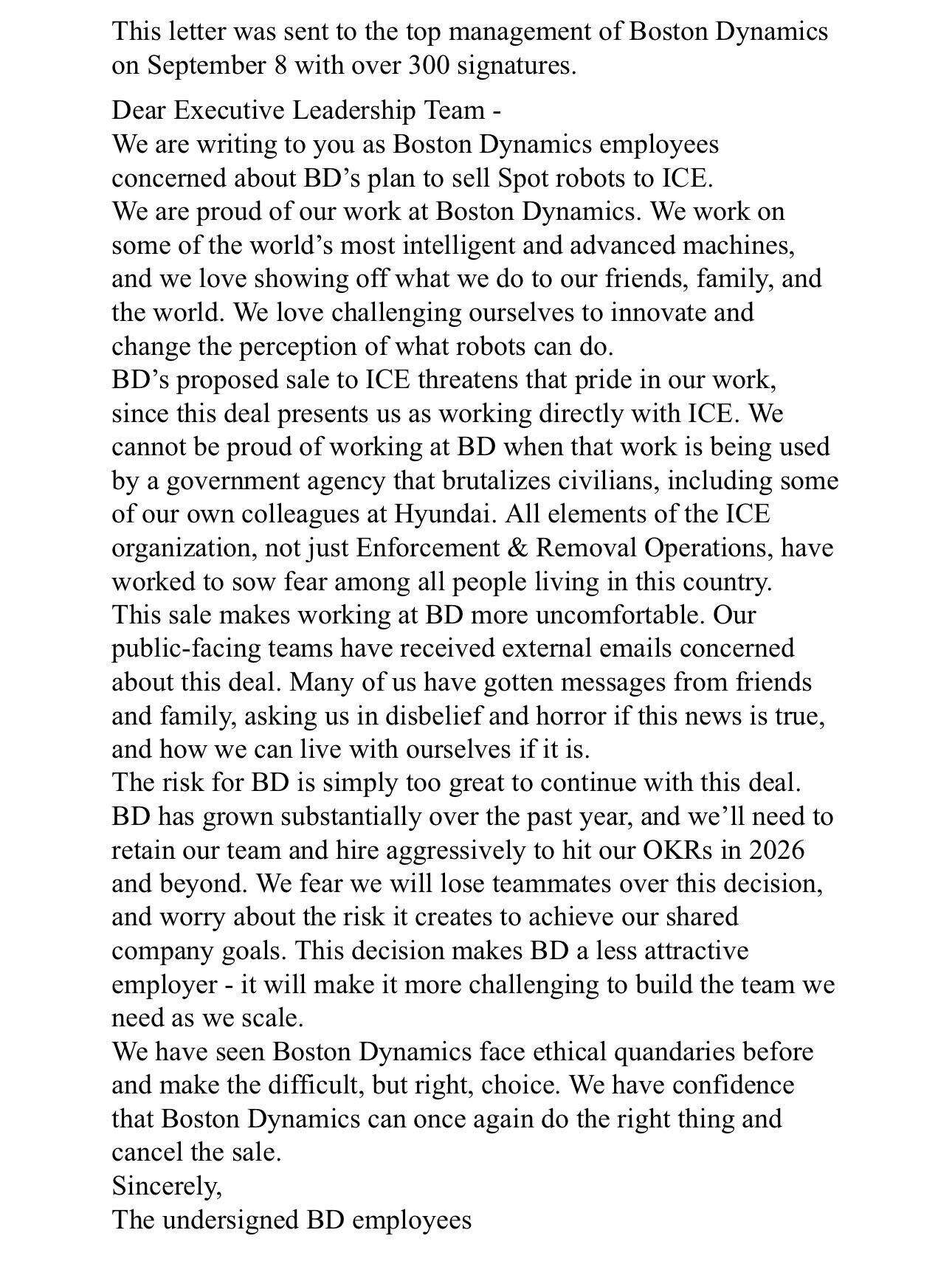
ICE plan to buy robot dogs spurs protest from hundreds of Boston Dynamics employees

26 October 2026 at 18:50

Hundreds of employees at the US robotics firm Boston Dynamics signed a petition calling for executives to halt a sale of the company’s robot dogs to US Immigration and Customs Enforcement—but executives stood by the deal, while saying the robots would not be weaponized.

On September 25, the Department of Homeland Security contract awarded $1.3 million to a Connecticut company called Radeco to provide ICE with modified versions of Boston Dynamics’ quadruped robots. But Boston Dynamics workers sent the petition letter with more than 300 signatures—half of them anonymous—to the company’s executives in early September and shared copies with The Boston Globe and WBUR public radio station.

“Many of us have gotten messages from friends and family, asking us in disbelief and horror if this news is true, and how we can live with ourselves if it is,” according to the petition. “The risk for Boston Dynamics is simply too great to continue with this deal.”

Read full article

Comments

© Radeco

Intel gets waiver after worries fuzzy US ban on foreign-made robots may hit fabs

23 October 2026 at 17:18

US chip champion Intel was so confused by the US government ban on foreign-made robots that it requested and received a waiver “out of an abundance of caution.” The tech company wanted to make sure that it could continue using certain robotic vehicles in its US chip fabs.

The uncertainty surrounding the Federal Communications Commission ban on certain foreign-made robots was revealed in the agency’s decision to grant Intel’s waiver request. On October 22, the FCC published its order allowing Intel to continue using the foreign-made robots in US semiconductor manufacturing facilities for a period of one year.

The robots in question are automated guided vehicles operating on “tracks or predefined paths” while often requiring operator oversight, according to Intel’s website. They help to move materials and items around within warehouses and factory floors.

Read full article

Comments

© Intel

Ukraine learns to fight without Starlink as Musk plays politics with satellites

23 October 2026 at 11:30

Elon Musk’s Starlink satellite service has played a pivotal role in supporting Ukraine’s successful resistance to Russia’s full-scale invasion for years. But with Starlink having become increasingly unreliable due to Musk’s political inclinations and the latest surprise disruptions to service in Ukraine, the Ukrainians and Europe as a whole are now facing urgent questions about how to move forward without it.

As the world’s largest communications satellite network, Starlink can typically support high-speed Internet and data streams for any user or vehicle equipped with a relatively compact Starlink terminal. This has enabled Ukraine to maintain vital communications for both civilian purposes and military operations—and has also expanded the Ukrainian military’s capability to remotely control or provide guidance to drones used in both air defense against Russian attacks and for striking back at Russian targets.

“Starlink currently offers some of the best satellite coverage available, with virtually no competitors when you consider the combination of cost, availability, and ease of use,” according to the head of hardware R&D at the Ukrainian defense company BlueBird Tech, who provided comments to Ars anonymously for security reasons. “In practical terms, the main limitation is the need to position the antenna so it can receive signals from the satellites.”

Read full article

Comments

© Dmytro Smolienko/Ukrinform/NurPhoto via Getty Images

Ukraine’s drone rescue of wounded soldier puts much touted idea into practice

20 October 2026 at 18:22

Ukraine’s unprecedented drone rescue of a wounded soldier from the battlefield has shown once again how battlefield necessity can spur innovation. The operation was revealed just days after separate Ukrainian drones designed for casualty evacuation were deployed for frontline testing—taking a step beyond the US military’s decades of experimentation with similar concepts.

The drone evacuation of the injured soldier took place at an undisclosed time and place on the frontline where the presence of Russian drones and landmines made it impractical to send in a wheeled ground robot, according to The Kyiv Independent. On October 19, Ukraine’s Army shared a video of the drone evacuation, showing the wounded soldier securing himself in a harness suspended beneath a heavy hexacopter drone with six rotors before being flown to safety.

“This is a historic event, the next stage of evacuating the wounded, which we will all come to,” said Napalm, a programmer of the 92nd separate assault brigade's unmanned ground systems company, who went by his callsign per Ukrainian military practice, in a statement. “Now the serious systematic work begins, so that such missions are carried out constantly.”

Read full article

Comments

© 92nd Separate Assault Brigade of the Ukrainian Ground Forces

Startup taps underwater volcano as energy source in "proof point" test

19 October 2026 at 19:27

The world’s first demonstration of a subsea geothermal power plant has taken place near an active underwater volcano almost a mile below the ocean surface. It generated less than 10 seconds of net-positive electricity but showed the technical feasibility of tapping another form of renewable energy underwater.

The three-week test deployment of the 3-ton prototype power plant took place at the Axial Seamount in the northeast Pacific Ocean in September. Endurance Energy, the Seattle-based startup behind the effort, aims to eventually commercialize subsea geothermal power for Pacific island nations and other customers looking for alternatives to importing expensive fossil fuels.

“The deep ocean gives us unlimited cold seawater for cooling, and its weight keeps the system and the well pressurized, so our plants can be compact,” said Andrew Redd, founder and CEO of Endurance Energy, in an email to Ars.

Read full article

Comments

© Endurance Energy

Stratospheric airship flew from US to Japan to test sky cell tower concept

19 October 2026 at 11:05

Nearly 100 years after the dirigible Graf Zeppelin made the first nonstop airship journey across the Pacific Ocean, another airship has successfully completed a round-trip flight from New Mexico to Japan and back. But the significance of this modern feat was less about the journey's length and more about its purpose: demonstrating how a lighter-than-air platform can act as a cell phone tower in the sky.

The trans-Pacific flight that took place over a month between August and September 2026 was the most notable milestone yet for Sceye, a US aerospace company based near Albuquerque, New Mexico. Sceye has developed an uncrewed platform filled with helium for buoyancy and equipped with an electric-powered propeller for active propulsion, allowing it to resist most strong winds and keep hovering over the same location for long periods. The platform also uses top-mounted solar panels and onboard batteries to stay powered for stratospheric operations around the clock.

“We can stay over an area of operation, and we do that in the stratosphere right around 60,000 feet, so we're twice as high as air traffic and we're above the jet stream, and yet 30 times closer than low-Earth orbit satellites,” Mikkel Frandsen, founder and CEO of Sceye, told Ars. “We can fly through day and night until the sun comes up the next morning and recharges the batteries, at which point we're still at the same altitude and still over the same area of operation.”

Read full article

Comments

© Sceye

Black Sea drone attacks enter NATO country's territorial waters for first time

15 October 2026 at 18:48

Russian drones are suspected of sinking a cargo ship and leaving chemical tankers ablaze near the Black Sea coasts of Bulgaria and Romania, respectively. The latest attacks mean that at least seven ships have been attacked in the exclusive economic zones of NATO member countries—and even within Romania's territorial waters if Russian involvement is confirmed in the case of the chemical tankers.

Such attacks have spurred requests for NATO to redeploy counter-drone systems to provide more protection. In a social media post on October 15, NATO Secretary General Mark Rutte stated that NATO had increased "counter-drone capabilities" along the alliance's eastern flank after meeting with the leaders of Bulgaria and Romania.

The latest attacks this week occurred within 24 hours between October 14 and October 15, when the two chemical tankers were set afire after Russian drones were detected in Romanian airspace, according to Deutsche Welle. Both ships were sitting at anchor near the mouth of the Sulina canal that connects the Black Sea to the Danube River, which has become a crucial shipping export route for Ukraine, Reuters reported.

Read full article

Comments

© Hristo Rusev/Getty Images

❌
❌